One drone operator says the Black Hornet can be flown ten meters away from troops without being heard.

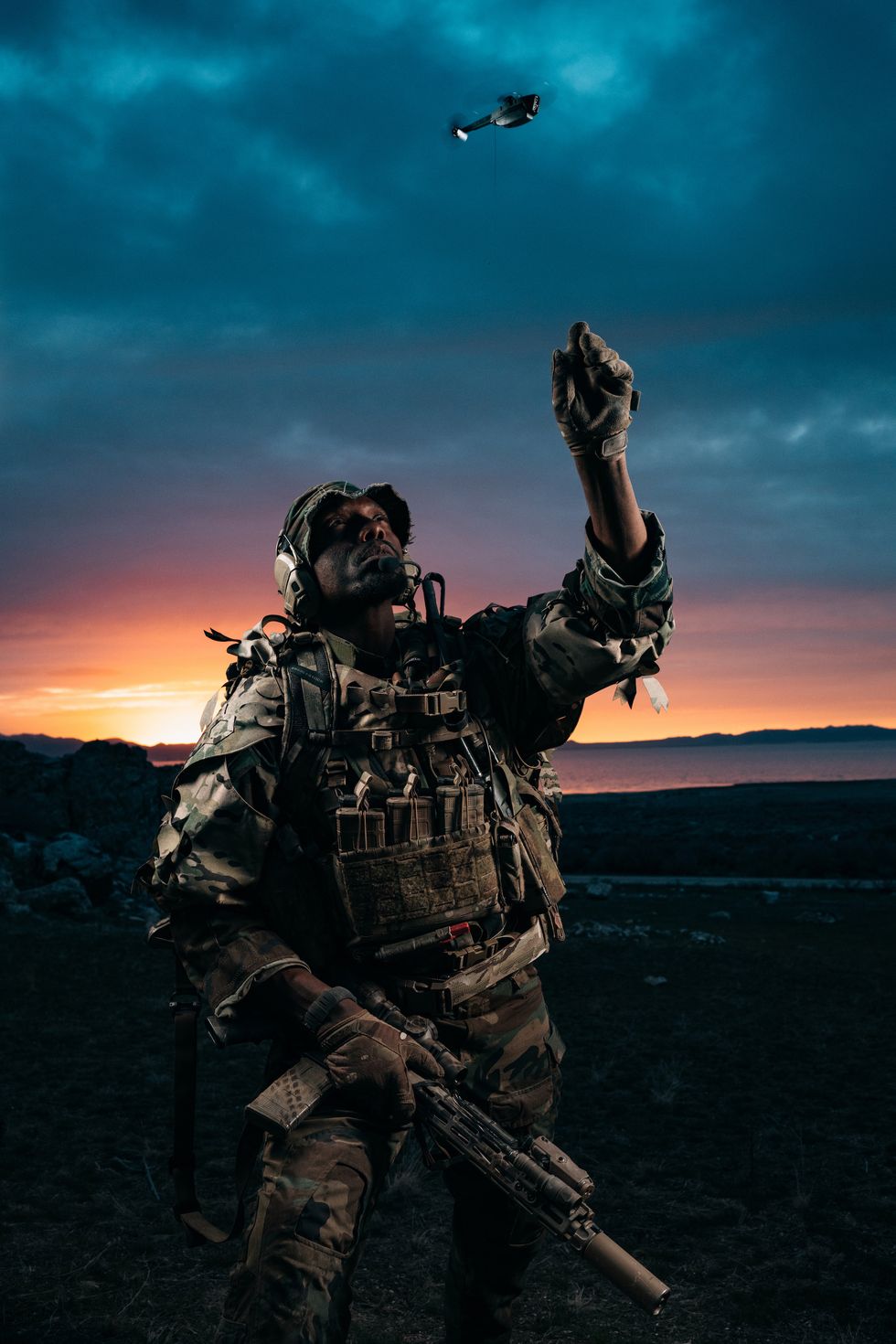
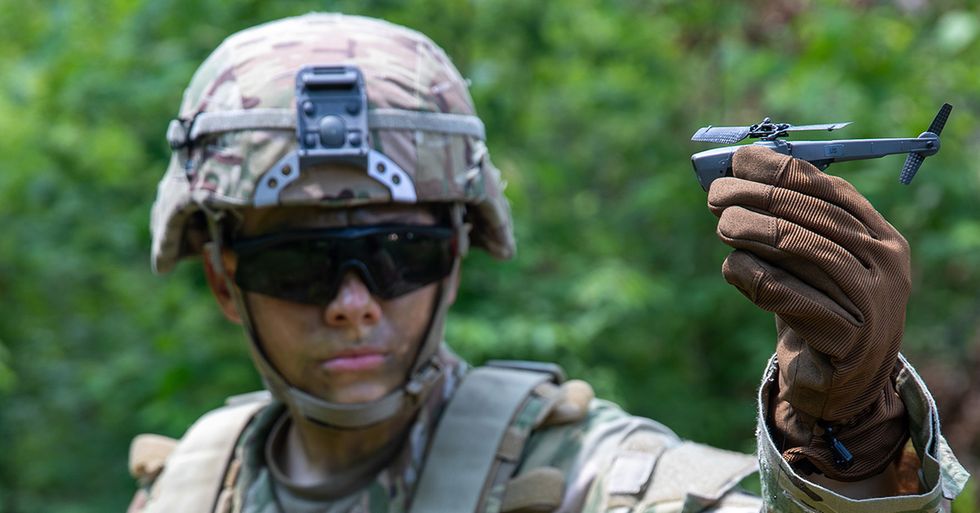
Groups of tiny nano-drone helicopters, known as “Black Hornets,” are buzzing the skies in Ukraine thanks to a round of U.S. defense funding for Kyiv over the summer and a pledge from Norway to send out 1,000 more of the miniature scouts. Claimed to be the smallest and lightest drone in military service, the Black Hornet Personal Reconnaissance System is compact enough to land on your palm and weighs under two ounces.
It’s the sort of gadget you would expect to see in 007’s well-tailored pocket—but what can it do on the battlefield?
Norway previously supplied a handful (so to speak) of the nano-drones, so we already have some feedback on its unique capabilities. Meanwhile, Dave Viens, vice president of business development at Teledyne FLIR Defense, which built the Black Hornets, tells Popular Mechanics that while specific feedback on the drones from Ukraine is a bit “sensitive” to share, that the tiny fliers “are being used very effectively.”

Engineering Nano-flight
The smaller a drone, the more it tends to get carried by the breeze. So how does the tiny Black Hornet maintain stability?
“That’s really a ‘secret sauce’ question,” Ole Jorgen Seeland, product director of personal reconnaissance systems at Teledyne FLIR Defense, tells Popular Mechanics. “A lot of the Black Hornet’s key parts are internally designed and manufactured … it’s something our competitors have yet to master.”
One obvious feature is that the Black Hornet is a helicopter, while most small drones are quadcopter drones. Seeland notes that, at small scales, helicopters are more efficient—there are toy quadcopters the size of the Black Hornet, but they have a flight time of just a few minutes, for instance.
Quadcopters have two blades rotating clockwise and two blades rotating counter-clockwise, so the torque cancels out. But the Black Hornet, like full-size helicopters, needs a tail rotor to prevent the body from spinning. Steering and stability are achieved by adjusting the angle of the rotor blades, which requires a complex arrangement of servomotors.
“In general, a helicopter is more mechanically difficult to build,” says Seeland.
Quadcopters steer by adjusting rotor speed. When the two rotors at the back go faster, the drone moves forward; when the two at the left go faster, it goes right, and so on. The drone remains stable in gusty conditions thanks to a flight controller, which reacts and adjusts all four rotors at lightning speed. The control challenge is simpler for a helicopter, making Black Hornets more stable than their equivalent quadcopters.
In addition, Black Hornets also sport counterweights on their rotor edges. These add mass to the blades so gyroscopic forces maintain stability.
Toward the Military Mainstream
The Black Hornet has a surprisingly long history. Norwegian inventor Petter Murren patented techniques to keep small drones stable in the early 2000s, and founded a company called Prox Dynamics, based near Oslo, which explains the Norwegian connection. The company first displayed Black Hornet prototypes in 2009, and two years later, the British Army was flying them in Afghanistan under the name PD-100 for “Personal Drone.”
Operators could reportedly only fly the original Black Hornet for about half its current flight time, and it struggled in strong winds. Control distance was limited to a kilometer, and the video was low resolution, but it was a hit with the soldiers who flew it.
“The Brits are very clear that this system has saved lives and added to force protection [and] situational awareness,” Arne Skjaerpe, then general manager of Prox Dynamics USA, told National Defense magazine in 2014.
The company went on to sell batches of the nano-drones to several foreign customers, eventually attracting the attention of the U.S. military, which purchased a test batch in 2019, and has since bought more. U.S. sensor specialists FLIR bought up Prox Dynamics in 2016, before Teledyne Technologies acquired FLIR in turn in 2021, marking a steady shift from the fringe toward the military mainstream.
Naturally, the biggest issue was cost. The U.K. paid £20m (about $25 million) for a batch of 324 Black Hornets; that translates to over $100k for each nano-drone in today’s money. As many drone operations note, small drones are inevitably going to get lost, so they need to be cheap enough to be expendable. Every time a Black Hornet was lost or broken was a painful experience: the accidental crunch underfoot was the equivalent of writing off a Porsche.
The New Black Hornet
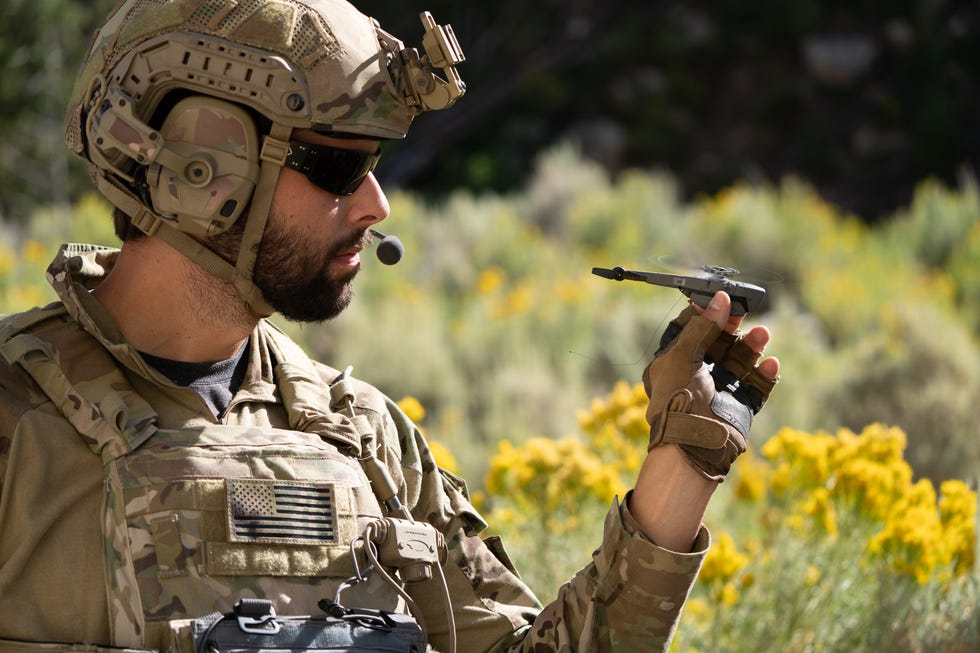
“Since the first Black Hornet was introduced in 2011, the technology has advanced significantly and the nano-drone has regularly received new features,” says Seeland. “Better cameras, faster processor, longer flight times, etc. All these improvements are aimed at giving soldiers faster and better situational understanding.”
The current-generation Black Hornet 4 is far more stable and can fly in gusts of up to 22 miles per hour. The weight has increased from 16 grams to 70 grams (or two and a half ounces), and it has better communications and cameras. The thermal display offers higher resolution—640 x 512 video, plus a 12-megapixel daylight camera. The drone is also more affordable; current Pentagon budget figures show prices at around $19k per drone. But the selling point is still stealth.
“Its visual signature when flying makes the Black Hornet a lot harder for adversaries to detect than military quadcopters,” says Seeland.
The big difference between then and now is the context. Back then, small drones were limited to the elite few. Now, anyone can get one. The skies of Ukraine are abuzz with thousands of small consumer quadcopters carrying out the sort of reconnaissance that was previously only possible with military hardware. Popularly known as “Mavics” after the DJI Mavic series, the low-cost drones are everywhere, providing eyes in the sky for every infantry squad and artillery battery.
In this situation, the Black Hornet looks like just another drone among many. But, as reports from Ukrainian operators attest, the stealthy nano-copter, able to move around inside buildings, still has a uniquely valuable role.
Hornets on the Front Line
An anonymous drone operator from the Kruk UAV Training Center reported on his experience with the Black Hornet on the Center’s Facebook page. Stealth is good, both visual and audible. He says the Black Hornet can be flown ten meters away from troops without being heard, and that while it could be seen 50 meters away in the sky, against buildings or vegetation it was difficult to spot at twenty meters.
He notes the camera is not as good as the DJI models, which have 720 x 1280 resolution streaming video as standard (though new Black Hornet models do have improved cameras), but crucially that Back Hornet’s daylight camera could be swapped with a thermal imager for nighttime operations so it can fly when commercial drones are grounded.
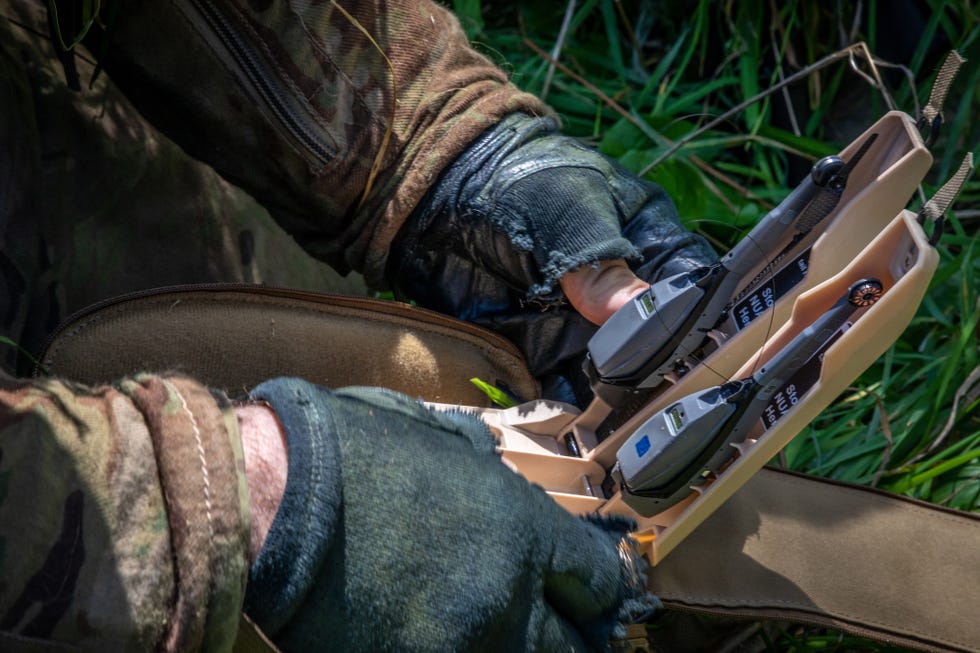
The Black Hornet also comes in a handy carry case/controller/charger unit which fits into a standard military MOLLE (Modular Lightweight Load-carrying Equipment) pouch, and for this, the operator rates it a 9/10. Unlike other drones, the controller allows Black Hornet to be operated with one hand. The ergonomics are clearly superior to drones designed for recreational use.
In terms of employment, the operator says that the Black Hornet’s main value is for close-range reconnaissance. The tiny drone can scout out the interior of buildings or look into trenches or other positions just ahead of the assault. This ability to go in first makes it a life saver, preventing deadly surprises to the attack force.
“Does not exactly replace Mavics,” he concludes. “A completely different class and usage scenarios. … A cool highly specialized drone for reconnaissance.”
The Takeaway
Drones in Ukraine are evolving in a way that parallels the development of early aircraft in WWI. General-purpose biplanes gave way to different types dedicated to air-to-air combat, ground support and heavy bombing. The Black Hornet corresponds to light reconnaissance aircraft, and its ability to operate in close proximity to troops, while being handier and more portable than other drones, makes it a valuable tool.
While it may be expensive by the standards of consumer drones, it’s still one of the more affordable pieces of military hardware. And in exchange for Black Hornets, the Pentagon will get something priceless: detailed information on the best way for the American military to use its own nano-drones in 21st-century warfare.
Because if there’s one thing this conflict has shown, it’s that small—and very, very small—drones are here to stay.
